
Reviewed · WALKING TOURS
Sofia Hidden Gems: Small-Group Walking Tour with Tram Ride
Sofia is a city you feel fast, not just see. This small-group walking tour ties together Orthodox churches, Roman Serdica remains, big cultural stops, and a short tram ride so you get your bearings quickly without rushing.
I really like the mix of eras in one route, from the ancient rotunda and archaeological complex to the National Theatre and Largo. I also like that the guide is Peter, and from what you’ll experience on the ground, his approach is patient, energetic, and focused on answering questions.
One possible drawback is simple: it’s a 2 to 3 hour walk, with several short indoor moments and more outdoor time than you might expect. If the weather is hot, you’ll want to follow the basic advice and bring sunscreen.
Key highlights to look for
- Up to 10 people keeps the questions coming and the pace manageable
- English guide plus tram/metro short ride helps you connect sites without draining your legs
- Several stops are listed with free admission (great for value when you’re planning a tight budget)
- Roman Serdica meets major Sofia landmarks in a route that stays coherent
- Kvadrat 500 and major civic buildings give you a modern look alongside the oldest layers
- Meeting at St. Sofia Church and ending near Central Market Hall makes it easy to roll into food or a second visit
A tight route that gets you oriented without burnout
This is the kind of tour that helps you understand Sofia’s layout. You start in the old core and then thread through landmarks that explain how the city grew from ancient Serdika into a modern capital.
The timing also makes sense. Even though you hit a lot of places, most stops are short, which means you spend more time moving with context than waiting around with no plan.
If you prefer long museum hours, this might feel brisk. But if you want the quick “how Sofia works” overview, this route does that job well.
More Walking Tours in Sofia
- Sofia: Communist Walking Tour
★ 4.9 · 1,106 reviews - Sofia: City Monuments Guided Walking Tour with Audio Guide
★ 4.5 · 825 reviews - Communist Walking Tour of Sofia
★ 5.0 · 690 reviews
Where you start: St. Sofia Church and a smart first impression
Your tour begins at St. Sofia Church, right in the Old City Center (ul. Paris 2). This matters because it sets the tone: you’re in the oldest symbolic heart of Sofia before you hop to anything else.
The Church of Holy Wisdom dates to the 4th century, and it’s tied to a major early event in the region, the Council of Serdica (held most probably in 343 with 316 bishops in attendance). The story gets even better when you connect the dots, because the church’s name is also linked to the city’s identity. Sofia was previously known as Serdika.
Practical note: the stop is short, so come ready to absorb. You’ll get the highlights and keep the momentum.
St. Alexander Nevsky Cathedral: the big Neo-Byzantine moment
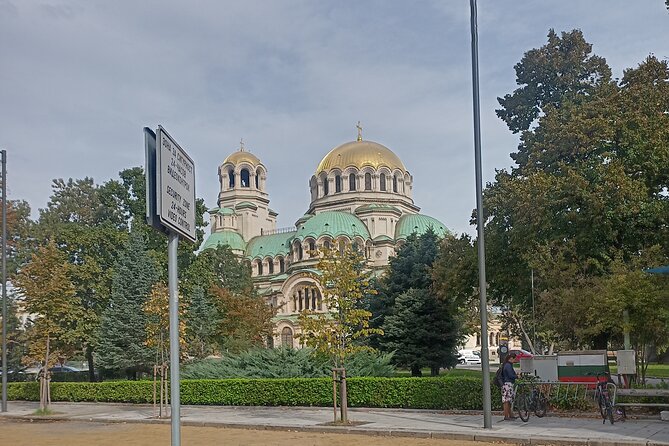
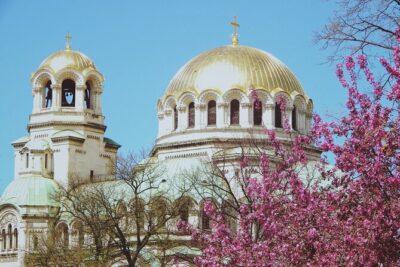
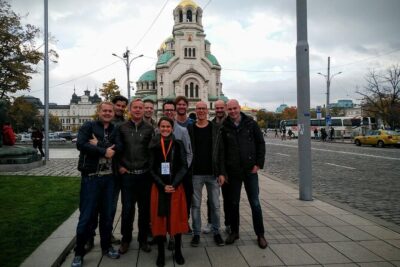
Not long after, you’ll step into the visual drama of St. Alexander Nevski Cathedral. It’s a Bulgarian Orthodox cathedral in Neo-Byzantine style, and it’s one of the 50 largest Christian church buildings by volume in the world.
This is the stop where the scale of Sofia shows up. The cathedral is less about whispering details and more about “wow, this is what power looks like in architecture.”
It’s also a good change of pace from the older layers. You’ll feel the shift from ancient and early Christian roots into a later, monumental religious identity.
Kvadrat 500: a modern art hit, without turning the day into a museum marathon
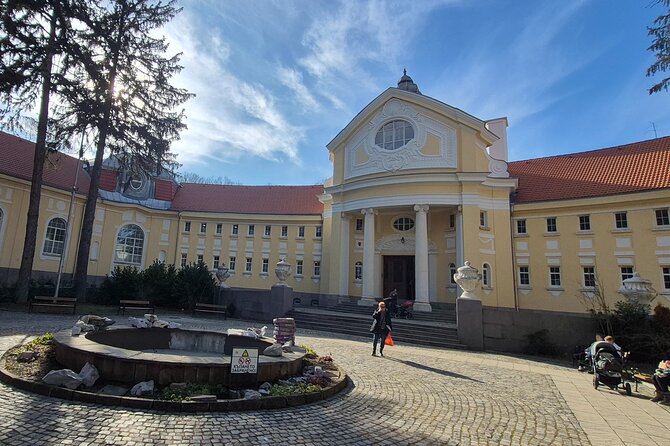
Next up is Kvadrat 500, the newest and largest building of the National Gallery, opened on 25 May 2015. The quick stop gives you a taste of how Bulgaria presents art across time.
You’re told there are about 1,700 artworks on view out of a larger collection of over 42,000 museum pieces, spread across 28 halls on four levels. The collections are also arranged to show different cultural paths, including Bulgarian work dating back to the 1890s, and a larger foreign component formed in the 1980s.
The standout part for planning is variety. The exposition traces Bulgarian art from the mid-19th century and 20th century, and it also covers European art from the 15th-19th centuries, plus art from Asia, Africa, and America.
Drawback to keep in mind: because this is a guided walking tour format, you won’t get a full gallery day. If you’re an art deep-dive type, you might want to treat this as the sampler and plan a return visit later.
A few more Sofia departures leaving the same week
- Sofia Highlights 2 Hour Sightseeing Walking Tour
★ 5.0 · 442 reviews - Guided Walking Tour of Sofia
★ 5.0 · 143 reviews - Private city walking tour of Sofia
★ 5.0 · 141 reviews - Sofia Walking Private City Tour
★ 5.0 · 127 reviews
The National Library: a fast tour inside a book treasure
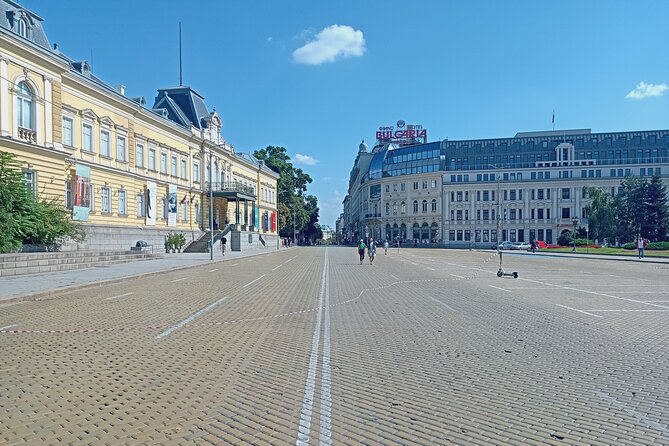
One of the best value moves on this route is the visit to the St. Cyril and St. Methodius National Library. You go inside, and the impact is immediate even if the stop is brief.
The library’s scale is staggering: today it holds nearly 8.5 million documents, and each year it receives around 70,000 publications. It’s also described as Bulgaria’s largest book treasury.
This is a good stop for anyone who likes culture that doesn’t depend on flash. It’s quietly important and surprisingly inspiring once you understand what “millions of documents” actually means in a modern city.
Sofia University and the neo-Renaissance building you’ll remember later
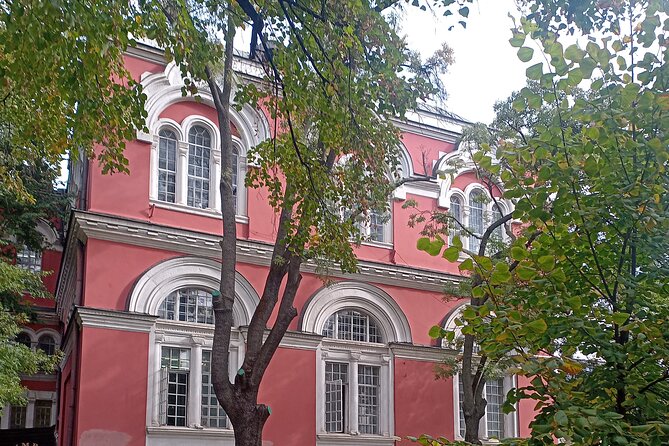
You also visit Sofia University St. Kliment Ohridski. The tour frames it as the first higher educational institution in Bulgaria, and it ties that role to early Bulgarian teaching activity that dates to the second half of the 9th century.
The story then moves through the Bulgarian Renaissance and the post-1878 Liberation period, when the idea of higher education took on a stronger mission. That context helps you look at the buildings as more than scenery.
When you focus on the architecture, the key detail is the façade. The university building was built 1884 to 1886, designed by Constantin Yovanovic, who studied in Vienna and Switzerland. The style is neo-Renaissance, which makes it feel both historic and deliberately “grown up.”
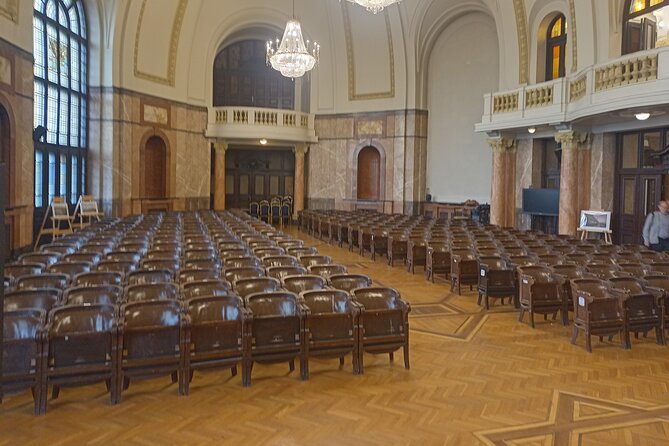
National Theatre, Largo, and the city’s performance side
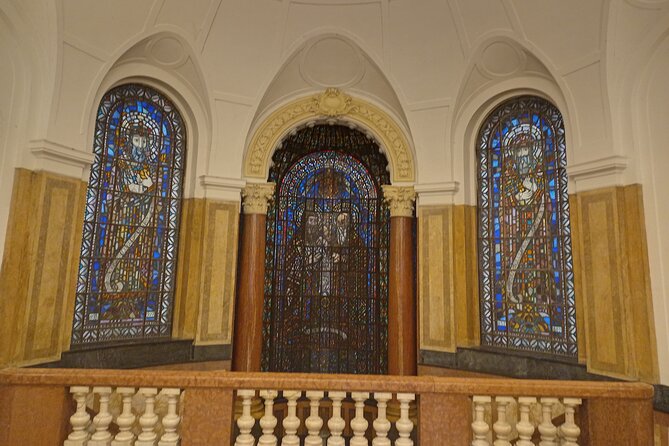
After the academic stop, the route turns toward public life and the arts. You’ll pass by the historic development behind the opera and theatre tradition, then land on the major stage building.
Here are the dates that help you place it in time:
- The National Theatre building was finished in 1906, with an opening ceremony on 3 January 1907
- It was designed by Ferdinand Fellner and Hermann Helmer
- The auditorium holds 848 seats
- The plafond and walls of the auditorium were painted by Rudolf Fuchs from Vienna
- The style is described as Art Nouveau
There’s also an earlier note tied to opera. In 1890, three Bulgarian musicians, Dragomir Kazakov, Ivan Slavkov, and Angel Bukoreshtliev, organized the first opera troupe in Bulgaria as a branch of the Sofia Drama and Opera Troupe. The performances included full operas and excerpts, and the idea was joined by participants from different countries.
Then you hit Largo, described as an ensemble of three Socialist Classicism edifices built in the 1950s to become a new representative center for Sofia. This is the kind of contrast that makes the tour feel useful. You’re not just seeing old and new, you’re seeing how the city kept reinventing what matters.
Rotunda of St. George and the “under your feet” Serdica complex
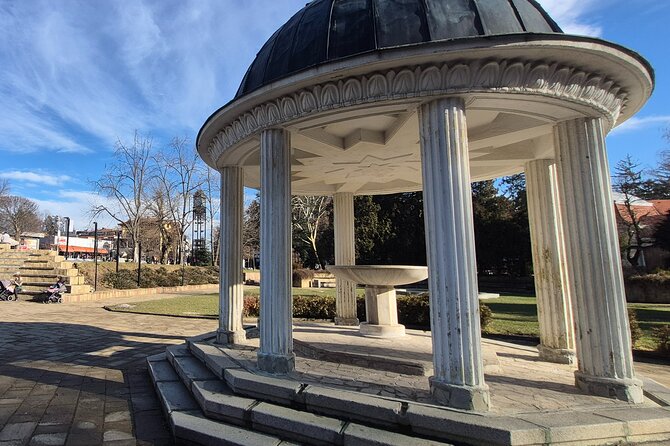
This is where the tour earns its staying power. You go to the Rotunda Church of St George, a Late Antique red brick rotunda built in the early 4th century as Roman baths. Later, it became a church inside the walls of Serdica. It’s considered the oldest building in modern Sofia and belongs to the Bulgarian Orthodox Church.
Then the tour moves into the Ancient Serdica Archaeological Complex. The layout is explained in a way that helps you visualize what you’re standing on. There are two zones, and the “Largo” zone sits underneath Nezavisimost Square.
You can see parts of one of the main Roman streets, the decumanus maximus, connecting the eastern and western gates. There’s also a large residential building covering an entire insula, plus small shops that would have served locals and visitors. A lapidarium is located nearby.
Stop time is built into the schedule, so you won’t get lost. The payoff is that you’ll understand the ancient city as a functioning place, not just a set of stones.
Central Mineral Baths and the synagogue story you can’t unlearn
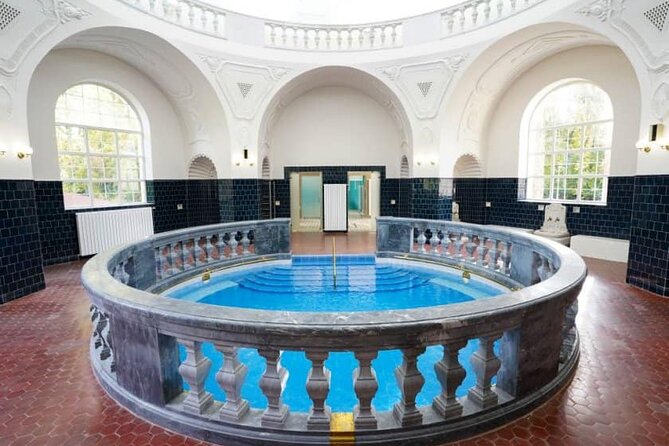
Sofia’s bath culture shows up through Central Mineral Baths near Banski Square. The current building was designed in Vienna Secession style but with typically Bulgarian, Byzantine, and Eastern Orthodox ornamental elements. It was built in 1904 to 1905, approved on 30 January 1906.
This stop is a good one if you like architecture that mixes influences without pretending they’re identical. Even if you don’t go inside for a soak, you’ll see how Sofia used design to signal identity.
From there, you get a highly specific cultural story tied to the Central Sofia Synagogue. The tour describes how, in the early 20th century, the Jewish community collected donations and invited Friedrich Grünanger, a Viennese architect, to prepare the synagogue project. Construction took about four years.
You’ll also learn that tombstones from an old Jewish cemetery were used for the synagogue base, and that the construction cost is listed as 437,000 golden leva. The synagogue is said to be built on the old site of another synagogue, known with the Hebrew name Ahava ve Chesed (Love and Goodness).
If you like history as lived experience, this is the part that tends to stick. The facts are detailed, but the route keeps it human, not academic.
West Gate and Zhenski Pazar: where Sofia meets everyday life
To end the sense of “ancient city structure,” the tour includes the West Gate of Sofia. This is the Western Gate of Serdica, protected by towers, including a preserved section with a pentagonal tower near the gate and a triangular tower nearby.
It’s also placed in the modern city grid, located between St. Joseph Catholic Cathedral, Todor Alexandrov boulevard, and the Monument Symbol of the City of Sofia. That positioning helps you understand why those old gates matter, because they’re still part of how you move today.
Then you visit Zhenski Pazar (Women’s Market). It’s described as the oldest market in Sofia, established more than 140 years ago. It remains one of the most important trading centers in the metro area, which makes it a perfect stop for a quick feel of local life.
This isn’t a long shopping spree stop. It’s more about letting your senses catch up after all the stone and architecture.
The tram/metro short ride and why it is included
One of the smartest parts of this tour is what it doesn’t force you to do. You get a city transport card plus a tram or metro short ride included.
That matters in a practical way. Sofia can have sight-to-sight gaps, and walking every single segment would drag the day out. The transit snippet keeps your energy for the places that actually need time.
It also helps you connect the route logically. You’ll start to see how the old core links to newer areas, rather than treating everything as separate “tour stops.”
And because you’re not guessing how to pay or which line to take, your mental energy stays on learning.
What you’ll feel on the ground: Peter’s calm, question-friendly style
The guide experience is a big part of the value here. The tour is run by Peter’s Tours, and the guide you meet is Peter.
From the details you’ll hear on the walk, his style is described as patient and energetic. He’s also said to be willing to answer questions about Bulgaria, not just recite dates. That’s a real difference between a tour that checks boxes and one that helps you connect the dots.
You’ll also get a sense that he works around your pace. If you stop for small things like souvenirs, the guide is described as waiting so you don’t feel rushed out of the moment. There’s even mention of him inviting water, which sounds small, but it signals care when you’re out walking in the city.
Finally, one of the most useful notes is that you may get bonus locations beyond the main planned stops. That’s exactly the kind of extra that helps a first-timer start exploring on their own after the tour ends.
Price and value: what you get for $45.66
At $45.66 per person, this isn’t a freebie, but it’s also not an all-day museum investment. It’s priced like a focused orientation tour.
What you’re paying for:
- An English guide
- A city transport card and a tram/metro short ride
- A small-group feel, with a maximum of 10 travelers
- Mobile ticket convenience
- Multiple stops where admission is listed as free, including several key churches, the library, the university, and specific archaeological and bath-related sites
The best value angle is that the tour compresses a lot of Sofia meaning into a single outing. If you tried to stitch this together on your own, you’d likely spend time planning transit and re-checking opening details for each interior stop.
One planning note: this tour is on average booked about 25 days in advance, which hints it’s popular. If your dates are fixed, don’t wait until the last week.
Who should book this Sofia walk, and who might prefer something else
This tour is a strong match if:
- You’re in Sofia for a short time and want a structured route that explains the city
- You like a mix of architecture, religion, and ancient ruins rather than one single theme
- You prefer a small group where you can ask questions and get direct answers
- You want a quick look at major culture stops like Kvadrat 500, without committing a full day to one museum
You might consider a different option if:
- You want long, slow stays inside museums and galleries
- You dislike walking for 2 to 3 hours, even with breaks and quick stop windows
Also, do not ignore the weather. The tour advice is to bring sunscreen, and that’s not a suggestion you want to learn the hard way.
Should you book this tour?
Yes, if you want Sofia’s main threads tied together in one smooth 2 to 3 hour outing. This is the kind of tour that helps you understand why the city feels layered, from 4th century roots to modern cultural institutions, with a tram ride that keeps the day moving.
Book it especially if you like the idea of Peter guiding in English and you value a guide who answers questions and keeps things friendly. Skip it only if you’re chasing deep time in one place, because this is designed for breadth, not marathon museum time.
If you want, tell me your travel dates and what you care about most in Sofia, churches, Roman remains, or museums, and I’ll suggest how to pair this with your next stop after the tour ends near Central Market Hall.
FAQ
What is the duration of the Sofia walking tour with tram ride?
The tour is listed as lasting about 2 to 3 hours.
How much does the tour cost?
The price is $45.66 per person.
Is the tour offered in English?
Yes, the tour is offered in English.
How many people are in the group?
This experience has a maximum of 10 travelers.
Where do I meet and where does the tour end?
You start at St. Sofia Church, Old City Center, ul. Paris 2, 1000 Sofia, Bulgaria. The tour ends near the Central Market Hall of Sofia, Central Sofia Market Hall, bul. Knyaginya Maria Luiza 25, level -1, 1000 Sofia.
Can I cancel for free?
Yes. You can cancel for a full refund if you cancel up to 24 hours in advance of the experience start time.
Written up most recently in Sofia
- Small Group Tour to Belogradchik Fortress&Venetsa Cave from Sofia★ 5.0 · 3 reviews
- Private Sofia Half Day Eco Tour★ 4.4 · 3 reviews
- Rila Mountain Winter Day Trip★ 5.0 · 3 reviews
- Private Winter Day Trip to the Rila Mountain★ 4.5 · 3 reviews
- Lovech, Devetashka cave and Krushuna waterfalls★ 5.0 · 3 reviews
- From Sofia The Beauty of the Countryside and a Homemade Lunch★ 5.0 · 3 reviews
- Bulgaria and Serbia Full Day Tour from Sofia★ 5.0 · 3 reviews
- Private tour to Rila monastery, Wine degustation, Boyana church★ 4.5 · 3 reviews
Walking Tours, compared.
City Monuments Guided Walking Tour with Audio Guide
Read our review →
Sofia Highlights 2 Hour Sightseeing Walking Tour
Read our review →
Seven Rila Lakes Snowshoe Walk & Thermal Spring Pools
Read our review →Browse the lists this tour appears in