
Reviewed · AUDIO TOURS
Plovdiv Old Town Self-Guided Audio Tour
Plovdiv is a city where centuries stack on top of each other, and this self-guided audio tour helps you read the Old Town as you walk. You get a clear route through major landmarks without having to match your pace to anyone else.
I like the freedom most. You can stop when something catches your eye, then keep moving at your own speed with step-by-step audio. I also like how the walk strings together big visual hits, from the Roman Theatre to the medieval gates, so you finish with a real sense of how Plovdiv grew.
One possible drawback: you rely on your phone for the map and the audio, and on bright days a PDF-style map can be harder to read. If your screen struggles in sun, plan a little extra time and keep the brightness up.
Key things you’ll notice on this Plovdiv walk
- A route built around Plovdiv’s layers, Muslim, medieval, Roman, and late antique sites all in one loop
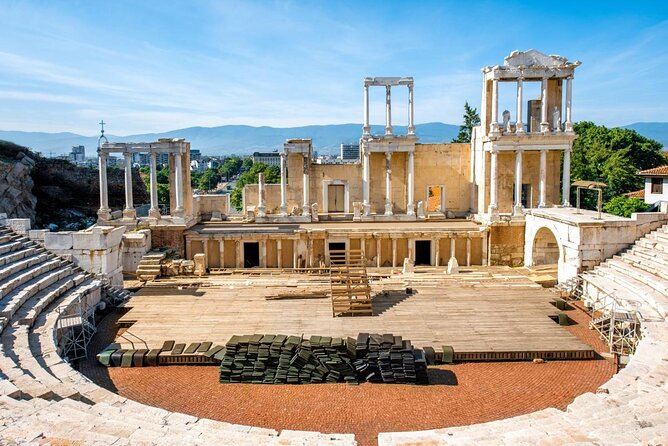
- Roman Theatre time is included, with a stop that puts you right where the views and stone details matter
- Free admission at many stops, but a few museums or archaeological sites have separate admission costs
- Easy pace control, the format is made for wandering, not sprinting
- A small food win, a 15 percent discount at a city restaurant can offset your snack or lunch
- A phone-based map challenge, some people find the zoomed-in map unclear, so prep your settings
Why a self-guided audio tour is a smart way to see Plovdiv Old Town
Group tours can be fun, but Plovdiv rewards slow looking. This format lets you do what you do best on a trip: pause for a view, read a plaque, then move on. The audio guide keeps you oriented and gives you the context so you are not just taking photos of random old stones.
The route is also built for variety. You are not spending the whole time staring at one type of landmark. You bounce between religious buildings, Roman public architecture, museum stops, and hilltop archaeology around Nebet Tepe.
If you have a couple of hours and want to cover a lot without feeling rushed, this is a strong match. It is also English, and it is designed for a moderate walking level, which matters in Old Town streets.
A few more Plovdiv departures leaving the same week
- Plovdiv: Old Town Self-Guided Audio Tour
★ 3.6 · 24 reviews - Roman Plovdiv, Self-Guided Tour and Urban Quest Game
★ 5.0 · 6 reviews - Plovdiv Roman Sights Self-Guided
★ 4.5 · 3 reviews
Start at the Ancient Stadium of Philippopolis, then walk the core of Staria grad
You begin at the Ancient Stadium of Philipopolis, in the Old Town area of Staria grad. The meeting point is listed on Hristo G. Danov Street, near the center of Plovdiv Old Town, and the tour ends back at that same meeting spot.
That layout is handy. You do not need to hunt for a pickup later, and it makes it easier to plan your day around the rest of Plovdiv. Opening hours are daily from 9:00 AM to 6:00 PM, so you have choices if you want to start earlier or later.
On a practical level, this kind of central start also reduces stress. You can look up your route once, walk it comfortably, and then spend your remaining time back in cafes and nearby sights rather than spending your energy figuring out transportation.
Stop 1: Djumaya Mosque, where you feel Plovdiv’s medieval Muslim era
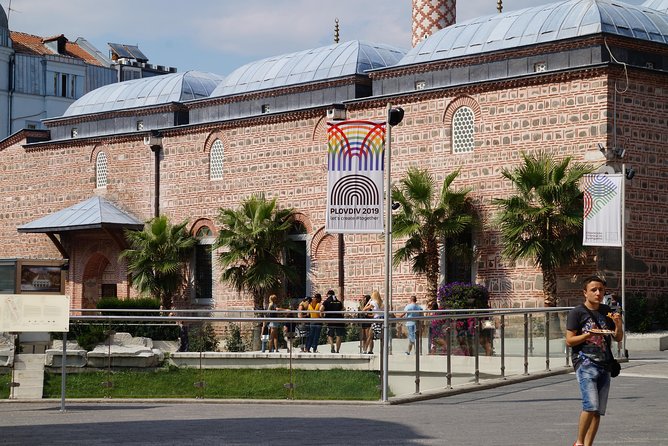
Your first stop is Djumaya Mosque. It is described as a medieval Muslim temple, built under Sultan Murad I (1362 to 1389) or Sultan Murad II (1421 to 1451), depending on which author you follow.
Even if you only spend about five minutes, this is a powerful kickoff. Plovdiv did not develop in a single cultural lane. The Old Town tour frames the city as a long conversation of different eras, and this mosque gives you that early turning point.
Practical note: since the stop time is short, decide what you want most. If you want the story, listen closely. If you want the details, spend a bit longer and return to the audio when you are back on the route.
Stop 2: Ancient Stadium of Philippopolis, Roman sport and civic life
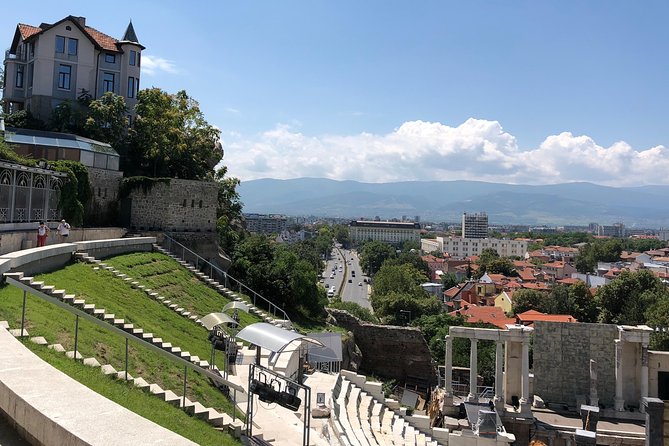
Next up is the Ancient Stadium of Philippopolis, a Roman stadium from the 2nd century AD, from the time when Philippopolis was in the Roman imperial orbit.
A stadium is one of those sights where the shape matters. Stand with the audio running and picture how public life worked when crowds filled these spaces. This stop is free for admission, so it is a low-effort, high-impact add.
If you like archaeology that is still “in place,” this is the kind of stop that clicks. You are not imagining everything from scratch.
A gentler use of the second half of a Plovdiv day:
- Private city walking tour of Plovdiv
★ 5.0 · 65 reviews - Plovdiv: Bachkovo Monastery, Asen Fortress, & Bridges Tour
★ 5.0 · 56 reviews - Plovdiv: Guided Walking Tour
★ 4.3 · 41 reviews - Food Walk: Bulgarian Food and Culture Tour in Plovdiv
★ 5.0 · 35 reviews
Stop 3: Church of the Holy Mother of God, a site with layered destruction
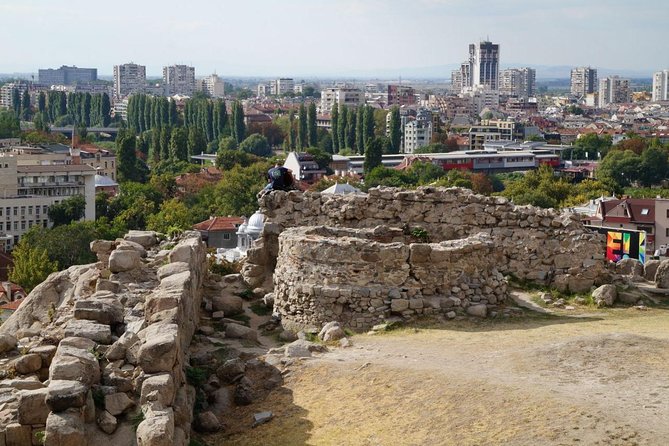
At the Church of the Holy Mother of God, the audio focuses on a long timeline. A small church existed here as early as the 9th century. It was renovated in 1186 by the bishop of Plovdiv, Constantine Pantehi, and became part of a monastery.
Then comes the hard part of the story. The church and monastery were destroyed when the Ottoman Turks conquered the city in 1371 during the Bulgarian-Ottoman Wars. Even in a short visit, it is a reminder that historic Plovdiv was shaped by conflict as well as faith.
This is a good stop to listen all the way through before you move on. The short stop time can make it tempting to rush, but the payoff is in letting the timeline land.
Stop 4: Casa Lamartine, symmetry and the big Old Town house look
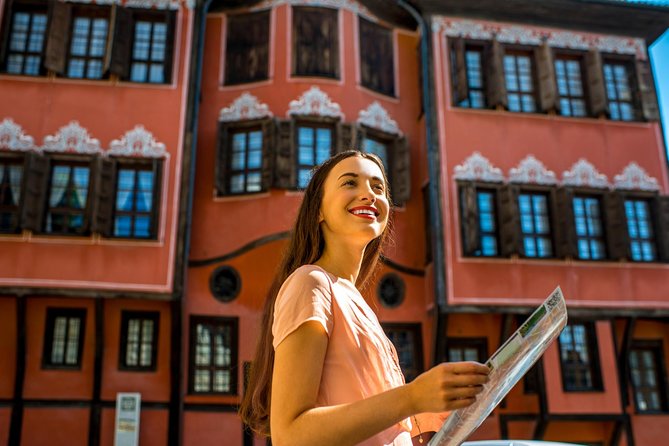
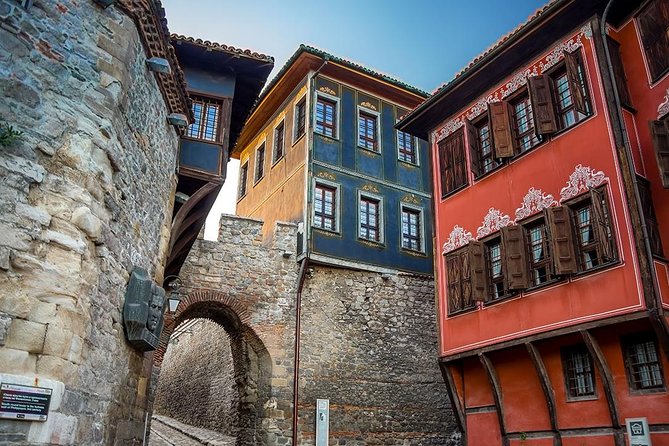
The Casa Lamartine stop is about Plovdiv’s 19th-century residential grandeur. The Lamartine House was built in 1829 to 1830 by an unknown master-builder and is described as one of the biggest and most beautiful symmetrical houses in the Old City.
Six minutes is not long, so treat this as a quick visual hit. Look for what “symmetrical” means on the facade and how the house sits within the Old Town street.
If you enjoy architecture and want the tour to add flavor beyond the Roman bits, this is a welcome change of tempo.
Stop 5: Balabanov House, a museum house from the early 1800s
Then you reach the Balabanov House, also known as the House of Hadji Panayot Lampsha. It is a museum house built at the beginning of the 19th century.
This stop tends to work best if you are the type who likes seeing how people actually lived. Even without extended time on paper, the museum-house format gives you a different angle than the religious and monumental sites.
You can also use this stop as a pacing reset. It breaks up the “big landmark” feeling and makes the Old Town more human.
Stop 6: Ancient Theatre of Philippopolis, the Roman highlight with city-center energy
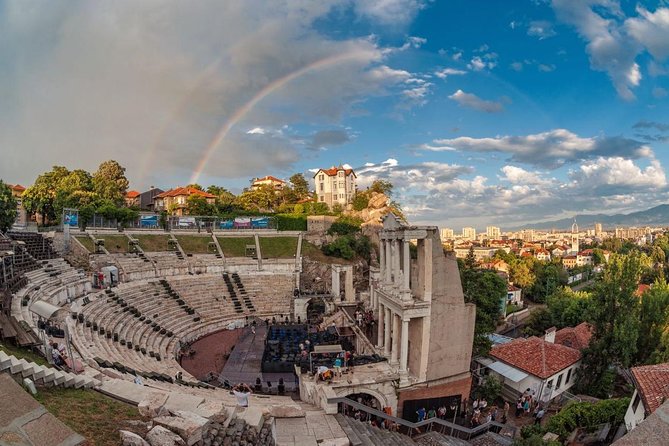
Now for the star: the Ancient Theatre of Philippopolis. The Roman theatre is described as one of the world’s best-preserved ancient Roman theatres, located right in the city center of modern Plovdiv.
Ten minutes sounds brief, but it is enough to do the two things that matter here. First, scan the seating and the stage area to understand the scale. Second, listen to the audio context so you are not just admiring stone, you are placing it into the life of Philippopolis.
This is one of the stops where you will naturally slow down, because the views and the sheer clarity of the structure make you want to linger. If your feet are tired, this is still worth prioritizing.
Adding the museum stops when you want more than archaeology
Not every interesting place here is included with free admission. A few stops are labeled with admission ticket not included, meaning you may want to pay on site if you want to go inside.
Ethnographic Museum (ticket not included)
The Ethnographic Museum is the second largest specialized museum of this type in Bulgaria. It is a short stop in the route. If you care about everyday culture and folk traditions, this is the one to consider adding, since the tour itself will only give you a quick introduction.
Archaeological Complex Nebet Tepe (free)
The Archaelogical Complex Nebet Tepe shifts you from city center monuments to hilltop origins. Nebet Tepe is one of the hills of Plovdiv where the ancient town was founded. The earliest settlements are dated back to 4000 BC.
This stop gives you perspective fast. You see the “why” behind Plovdiv’s long life, not just the “what” of Roman or medieval structures. The stop is 15 minutes and free, so it is a great use of time if you want more grounding in deep time.
Hisar Kapia and the Small Basilica for medieval and late antique texture
Hisar Kapia, a famous medieval gate moment (free)
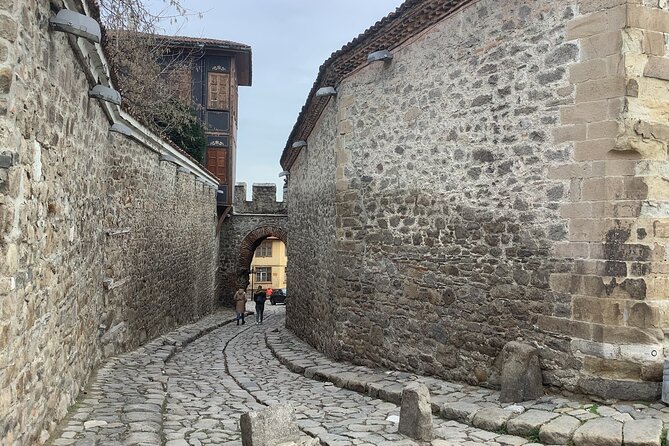
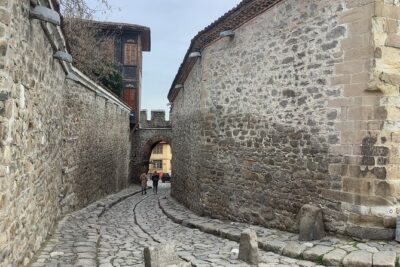
Hisar Kapia is a medieval gate in Plovdiv’s Old Town. Its name comes from Turkish, meaning Castle Gate, and it is one of the most famous tourist sights in the city.
Five minutes is enough here if you keep your expectations right. This is a photo and a story stop. The value is in recognizing it as a piece of the Old Town’s defensive and movement system, not just a picturesque arch.
Small Basilica of Philippopolis (ticket not included)
The Small Basilica is a 5th to 6th century archaeological site. Admission is not included, so you need to decide if you want to pay extra based on your interests.
If you like early Christian architecture and archaeology, this can be a satisfying capstone. If you just want the big outdoor sights, you might use this as a pass and spend that time listening, resting, or revisiting a favorite stop.
TrakArt Cultural Center, Roman mosaics and glass in ancient art (ticket not included)
The Cultural Center-Museum TrakArt is an art and history stop that stands out for what it specifically promises.
You are looking at 160 square metres of in situ ancient Roman mosaic from the 3rd to 4th century. There are also exhibitions on glass in ancient art, showing development from the 5th century BC to the 4th century AD. Another exhibit focuses on Protothracian portrait with ceramic objects from the Eneolithic and Neolithic periods. There are also Roman miniature portraits from the 1st century BC up to the 1st century AD.
That is a lot for one label, and the stop time is listed as 15 minutes. If you pay to go in, you may feel the clock. But if you like museums that connect everyday materials like glass to long timelines, this can be a great use of your ticket budget.
Church of Saints Constantine and Helena, built on older pagan ground (free)
The final major church stop is Saints Constantine and Helena. The audio frames it as among the oldest churches in Plovdiv. It was built in 337 at the sight of an ancient pagan temple on one of the fortified hills on the acropolis.
Ten minutes here gives you a strong sense of continuity and change. You are seeing how sacred spaces can move, adapt, and get reused across eras. It is a strong closing note because it ties religious history directly to the hilltop setting.
Timing and how to pace the 2 to 3 hours without rushing yourself
The tour is listed as 2 to 3 hours. In real life, that range mostly comes down to two things.
First, how long you linger at the Roman Theatre. It is hard not to. Second, whether you pay extra for the stops marked as admission not included, like the Ethnographic Museum, the Small Basilica site, and TrakArt.
If you want the full story with minimal museum spending, plan for about 2.5 hours. If you add one or two paid interiors, it can stretch toward the top end of the range. The good news is the format is built for pausing, not sticking to a rigid checklist.
You also have enough breaks baked into the route length between landmarks that it works even if you are not a fast walker.
Price and value, including the $15.49 ticket and the 15 percent restaurant discount
At $15.49 per person, this audio tour is priced like a city sightseeing add-on, not a full-day guided excursion. You are paying for a guided route and English narration that helps you understand what you are looking at while you walk.
Value here comes from the balance of included free-admission stops and optional paid ones. Many of the core landmarks are marked free admission, including Djumaya Mosque, the Ancient Stadium, the Church of the Holy Mother of God, Casa Lamartine, Balabanov House, the Ancient Theatre, Nebet Tepe, Hisar Kapia, and Saints Constantine and Helena.
Then you decide if you want to spend money on the museums and archaeological sites where admission is not included. That is a nice way to control your budget.
Also worth noting: you get a 15 percent discount at a city restaurant. Even a modest lunch can help make the ticket feel like a better deal.
Practical tips that will make your phone audio experience smoother
This is a self-guided format, so your success depends on small setup choices.
1) Use your phone brightness wisely
In bright Old Town sunlight, zooming into a PDF-style map can be tough. Before you start, try the map zoom you plan to use, then adjust brightness and text size.
2) Keep battery levels high
You are running audio and a map on one device. A portable battery is cheap insurance.
3) Plan for short stops
Several landmarks are around five to ten minutes. If you want longer photos, save it for one or two stops rather than trying to slow down at every location.
4) Expect separate museum decisions
Some stops are marked admission not included: Ethnographic Museum, Small Basilica, and TrakArt. If you want everything, budget extra time and a little extra cash.
5) Know where you finish
You end back at the stadium meeting point, so keep your next plan close by.
Should you book this Plovdiv Old Town Self-Guided Audio Tour?
I think you should book it if you want a structured walking route, strong context in English, and the chance to cover major Plovdiv landmarks in a couple of hours without babysitters.
Skip it or consider pairing it with other plans if you strongly dislike phone-guided navigation, because you do rely on a map on your device and it can be finicky in sun. Also, if you only care about one or two big sights, the pay-off of connecting many stops may feel like overkill.
If you are the type who enjoys Roman architecture, medieval street corners, and hilltop archaeology like Nebet Tepe, this tour style is a solid way to get your bearings and leave with a better mental map of Plovdiv.
FAQ
Is this tour self-guided or does it include a guide with you?
It is self-guided with a mobile audio guide. You follow the route on your own, and only your group participates.
How long does the Plovdiv Old Town audio tour take?
The duration is listed as about 2 to 3 hours.
What language is the audio guide available in?
The tour is offered in English.
Where does the tour start and where does it end?
It starts at the Ancient Stadium of Philipopolis in Staria grad, Plovdiv Center, ul. Hristo G. Danov, 4000 Plovdiv, Bulgaria, and ends back at the same meeting point.
Is the admission free at each stop?
Many stops are listed as admission free. Some stops have admission ticket not included, including the Ethnographic Museum, the Small Basilica, and Cultural Center-Museum TrakArt.
Do I need to bring a printed ticket?
You receive a mobile ticket.
What is the price per person?
The price is $15.49 per person.
Is the tour suitable for everyone physically?
It notes a moderate physical fitness level is required.
What is the cancellation policy?
You can cancel for a full refund if you cancel at least 24 hours in advance of the experience start time. Free cancellation is available, but refunds are not available if you cancel less than 24 hours before the start time.
Written up most recently in Plovdiv
- Koprivshtitsa History and Architecture: From Plovdiv★ 5.0 · 3 reviews
- Private Horse Riding in Rhodope Mountains from Plovdiv★ 4.0 · 3 reviews
- Full Day Tour to Koprivshtica and Starosel Thracian Tomb★ 5.0 · 3 reviews
- Plovdiv – Buzludzha and the Thracian kingdom valley★ 5.0 · 3 reviews
- Plovdiv Roman Sights Self-Guided★ 4.5 · 3 reviews
- Transfer Plovdiv to Sofia airport/city with a car 3+1★ 5.0 · 3 reviews
- Zip Line & Via Ferrata Experience in the Rhodope Mountains★ 3.5 · 3 reviews
- Tour from Plovdiv to Bachkovo,Asen Fortress and Wonderful Bridges★ 5.0 · 4 reviews
Audio Tours, compared.
City Monuments Guided Walking Tour with Audio Guide
Read our review →
Rila Monastery & Boyana Church – Audio guided tour
Read our review →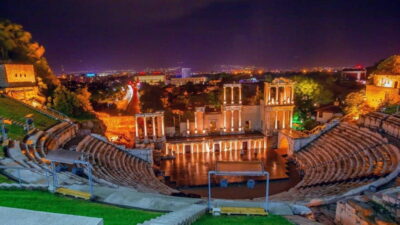
Sofia Audio guide Tour offers available in 7 languages
Read our review →
Audio Guide for Museum Paleontology and Historical Geology
Read our review →Browse the lists this tour appears in